


Veryan
Cornwall Information & Accommodation Guide
Veryan is a village and parish on the Roseland Peninsula with a coastline that stretches from Pendower Beach to Portholland.
The main settlements of the parish are Veryan Churchtown, Veryan Green and Portloe. Smaller hamlets include Carne, Camels, Trewartha and Treviskey,
Veryan parish contains several beautiful, sandy beaches - Pendower, Carne, Kiberick Cove and Portholland.
Veryan has been a place of human habitation for thousands of years. The earliest remains date from the Bronze Age. The burial mound (tumulus) known as Carne Beacon is one of the largest in the UK and is said to be the burial place of the 6th century King Geraint.
Nearby is Veryan Castle, an Iron Age hillfort, known today as the Ringarounds.
Melinsey Mill is situated within the parish of Veryan, on a pleasant walk between the Churchtown and Pendower Beach. It was built in 1565 to mill corn. The water mill has been restored. It stands in a wooded valley a mile away from Veryan Churchtown. Today, the building houses a small mill museum and a craft shop. Admission is free.
At the time of the Domesday Book of 1086 the area was contained in the manor of Elerchi (now Elerkey). The name is believed to derive from the Cornish word for 'swan' - 'elerch'.
The name Veryan is believed to have derived from a corruption of the name of Saint Symphorian, the Saint to whom the parish church is dedicated. By 1525 name was contracted to 'Severian' and then to 'Saint Veryan'
Veryan has sixty listed buildings - fifty-three Grade II, seven Grade II* and one Grade I.
The 13th century parish church is dedicated to St Symphorian. It has a tower south of the south transept which is unusual and a north aisle. It is partly Norman but mostly dates from the 13th and 14th century. There is no record of a church here before the Norman conquest.
The church was mentioned in the Domesday Book.
The Norman style carved faces on the west porch were added to the building in the 1830s by the local vicar who obtained them from the ruined chapel of St Nun at Grampound.
Circa 1110 the church was given to the monks of Montacute in Somerset by the lord of the manor of Elerky. Circa 1220 John de Montacute, gave it to the Dean and Chapter of Exeter, and they held it until 1859.
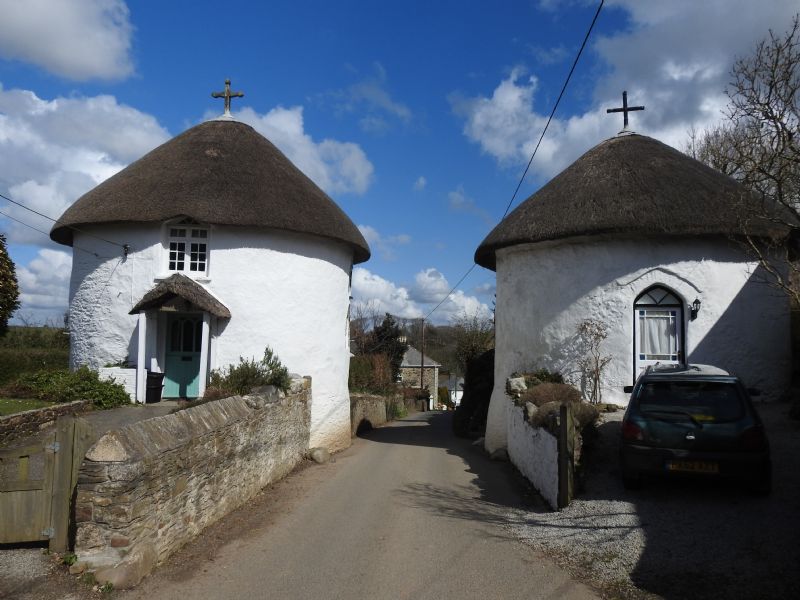
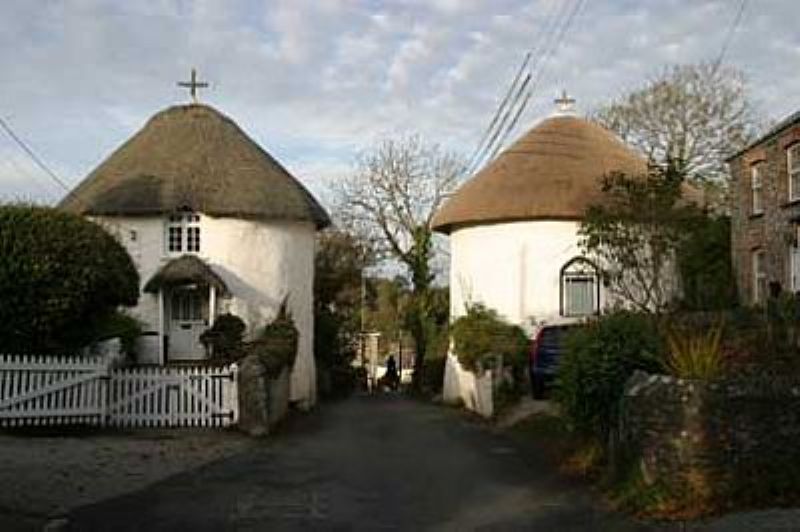
Veryan's most famous buildings are its five Roundhouses - circular buildings with thatched roofs, each with a cross on its roof to guard the village against the devil. Two pairs stand at each end of the village and the other is in the centre of the village. They were built in the early 19th century by Jeremiah Trist, the parish vicar. The houses are believed to be round so there are no corners for the devil to hide in.
The Reverend Trist was a missionary and persuaded his parishioners to regularly attend church. In addition to the round houses he is believed to have been responsible for the building of two schools.
During the Second World War Veryan became the site of the first above ground aircraft reporting post in Cornwall. Named the T2 Veryan Post, it opened in January 1942 and was located at Carne Beacon, an excellent position due to its open views. A wooden building was constructed which consisted of an observation area with aircraft plotting equipment, a place for refreshments and a covered area for shelter.
The post was in contact with the main operations centre at Truro by telephone. Observers had to report every aircraft within 10 miles. Later the post was equipped with a high frequency radio. The post was closed in 1962 and its activities transferred to Nare Head.
Today, you can still see the concrete foundations on the summit of Carne Beacon.
Veryan has a Post Office.
All ATMs throughout Cornwall.
If the information on this website has been useful to you please consider a donation.
This easy to use travel planner makes it simple. Just add the location in Cornwall from where you are travelling and the destination you wish to travel to and it will provide full details of times, buses, trains and ferries to get you to your destination.
Location:
On the Roseland Peninsula on the South coast of Cornwall
Books online:
Click here to buy books online about Veryan
Find all the Dog Friendly beaches in Cornwall
More archaeological sites in Cornwall
Places of interest in or around VeryanTowns, villages and other locations |
Cornish phrases and place names |
Topical phrases of the month October: 'Festival Phrases'
Place Name of the Month October: Karrekreun – Cargreen
|
Veryan Map |
|
Veryan Events |
|
Veryan Community Information |
|
Veryan Books |
|
Veryan Photos |
|
Veryan Videos |
|
Veryan History |

Veryan
Accommodation

in or around Veryan
Things to do
in this area


|
|

